
Edit with AI
Editing with AI
Ask for changes in your own words: one block, a whole new section, or the entire page.
When the change you want is bigger than fixing a word, you ask the AI for it in writing. There are three scopes, and it's worth knowing which to use, because they don't cost the same.
1 · A single block
Select a section (click its background) and the panel opens as Edit HTML block. Write what you want and hit Apply with AI: only that block changes, the rest of the page stays exactly as it was.
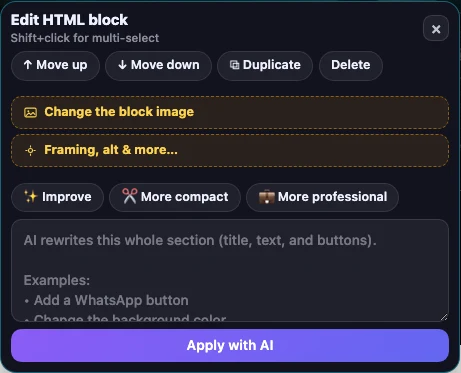
- 1Move the block, duplicate it or delete it. None of this uses AI.
- 2Shortcuts: improve it, make it more compact, or more professional.
- 3Or describe it in your own words and apply with AI.
In that same panel, with no AI involved, you can also:
- ↑ Up and ↓ Down — move the block.
- ⧉ Duplicate — create a copy right below.
- Delete — remove it. Undo brings it back.
- + Add blocks — tap other sections to add them to the selection and change them together.
2 · A brand-new section
The Section button in the toolbar creates a section that didn't exist, in your site's style. Pick one of the suggestions or describe your own: "pricing section with 3 packages".
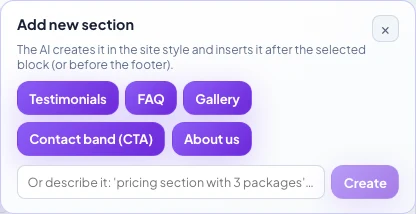
The section is created in your site's style and inserted after the block you have selected (or before the footer, if there isn't one).
3 · The whole page
In the rail's Edit tab there's the Edit with AI box. Here the AI regenerates the entire page from your instruction and creates a new version. It's the most powerful scope and the one that does use your full-page edit allowance.
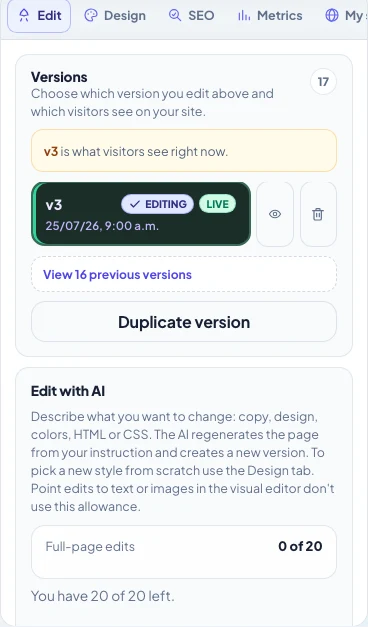
Below the box you can see how many you have left (for example "0 of 20"). Use it for deep changes: a different tone throughout, more breathing room between sections, a different way of ordering the content.
How to ask so it comes out well
- Say what, not how. "Make it clearer that we handle emergencies" works better than "add a red div at the top".
- One change at a time. Five instructions in one go tend to come out half-done; one by one they come out better.
- Say where. "In the services section…" narrows the work and avoids surprises elsewhere.